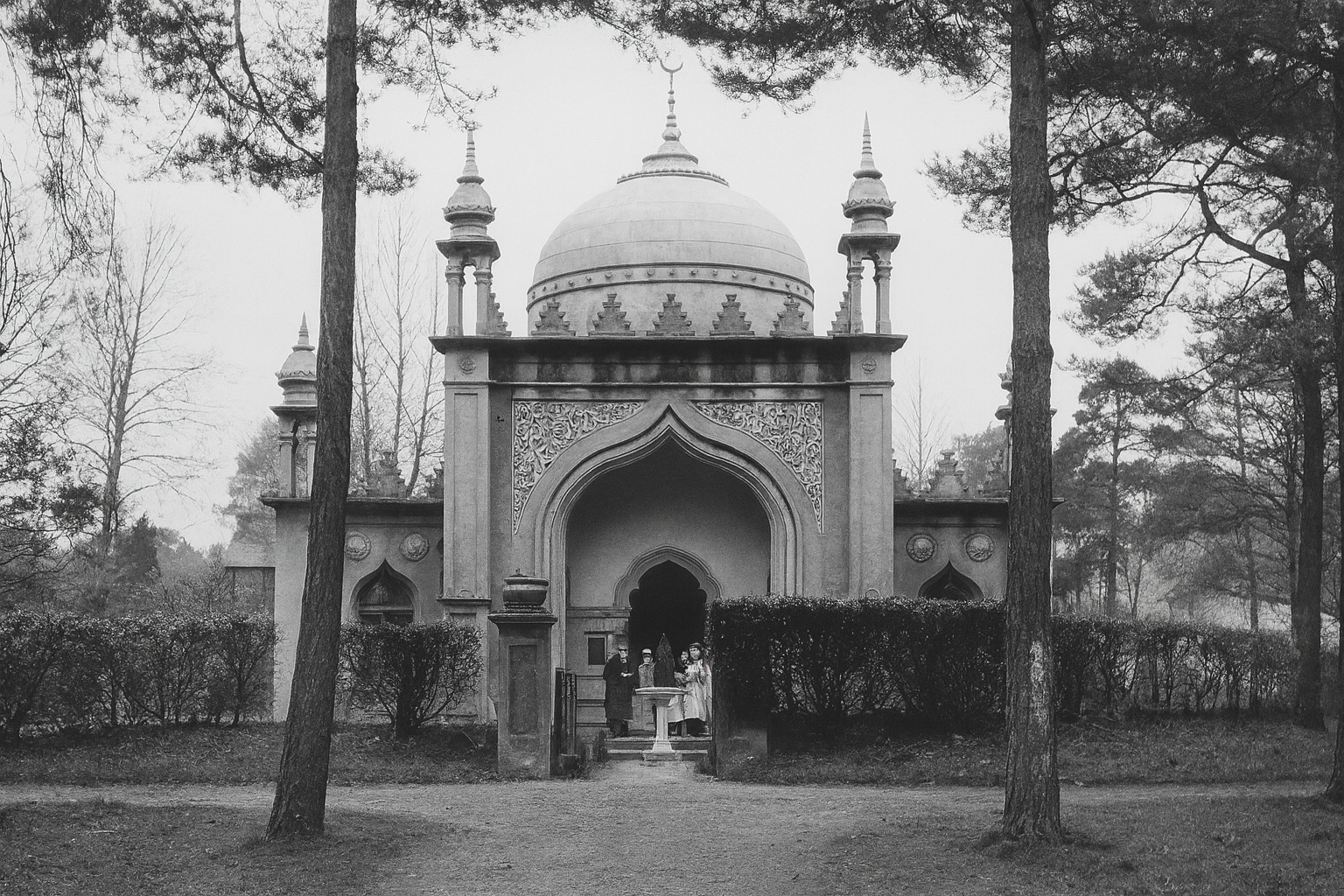
The Shah Jahan Mosque owes its existence to the remarkable vision of Dr. Gottlieb Wilhelm Leitner, an orientalist, linguist, and scholar born in Pest, Hungary, in 1840.
Leitner’s early life was extraordinary. After losing his father at a young age, he moved with his mother to Istanbul, where he studied at madrassah schools attached to local mosques. By his mid-teens, he had memorised large portions of the Qur’an and could speak eight languages fluently, including Turkish, Persian, Arabic, and several European languages.
His gift for language led to his appointment as Interpreter First Class at the British High Commission in Istanbul, a role carrying the rank of colonel. At just 17, he came to England, studied at King’s College London, and by his early twenties was already a professor of Arabic and Muhammadan Law there.
At 24, Leitner accepted the position of Principal at Government College Lahore (then British India, now Pakistan), later known as the University of the Punjab. His decades in India were devoted to advancing education, founding libraries, journals, and institutes, and building friendships with scholars and statesmen across the subcontinent.
Returning to England in the early 1880s, Leitner dreamed of creating an Oriental Institute, a centre of learning that would foster understanding between East and West. His search brought him to Woking, then a quiet town 30 miles from London, where he purchased the disused Royal Dramatic College. In 1883, he established his institute there, and in 1889, with a generous donation from Her Highness Sultan Shah Jahan, Begum of Bhopal, he built Britain’s first purpose-built mosque, today known as the Shah Jahan Mosque.
The Institute hosted visiting dignitaries from India and provided training for Europeans preparing for service abroad. By the time of Leitner’s death in 1899, it was affiliated with the University of the Punjab and awarding degrees. Though there is no record that Leitner himself embraced Islam, he remained a lifelong supporter and advocate for mutual understanding between faiths.
After Leitner’s passing, the mosque fell silent for over a decade. Then, in 1912, a visiting Indian lawyer, Khwaja Kamal-ud-Din, was moved by the neglected building and resolved to restore it. When he learned that the property was about to be sold for development, he appealed to the courts, arguing that the mosque was consecrated ground deserving the same legal protection as a church. He won the case and acquired the site for a nominal sum, safeguarding its future.
Khwaja Kamal-ud-Din’s leadership transformed the mosque into a vibrant Muslim Mission Centre. From his residence beside the mosque, he re-established daily prayers and launched the Woking Muslim Mission to share the message of Islam across Britain. His sincerity, learning, and humility attracted many to the faith.
Among the earliest converts was Lord Headley, a British peer and engineer who became one of the most influential Muslim figures of his time. Together, Khwaja Kamal-ud-Din and Lord Headley worked tirelessly to represent Islam with dignity and clarity, emphasising its equality, brotherhood, and reasoned faith at a time when British society was deeply divided by class.
Khwaja’s vision extended far beyond Woking. He established the respected journal The Islamic Review, which circulated throughout Britain and abroad, uniting new Muslims and educating the wider public about Islamic teachings. Early converts included prominent names such as Lord Stanley of Alderley, Charles William Buchanan Hamilton (Deputy Surgeon General), and others from across professional and social circles.
Khwaja Kamal-ud-Din’s message was simple yet profound: Islam, stripped of cultural divisions, is a faith of peace, compassion, and unity. His gentle character and unwavering sincerity embodied these ideals, and by the early 1920s the Woking Mission had become the intellectual and spiritual heart of Islam in Britain.
By 1924, there were an estimated 10,000 Muslims in England, about 1,000 converts, and many credited the Woking Mission for Islam’s growing presence. Until the 1950s, the Shah Jahan Mosque remained the pre-eminent centre of Islamic life in Great Britain.
Khwaja Kamal-ud-Din passed away in 1936, followed soon after by his close companions Lord Headley and Muhammad Pickthall, marking the end of an inspiring era.
After the Second World War, new Muslim communities arrived from across the Commonwealth, establishing mosques throughout the country. Though Woking’s national prominence diminished, it continued to serve faithfully as a local mosque for the growing community.
A touching story recalls Khwaja’s first visit in 1912. Upon opening a dusty Qur’an left on its stand, his eyes fell on the verse:
“Most surely the first house appointed for men is the one at Bekka, blessed and a guidance for nations.” (3:95)
Moved to tears, he prayed:
“O Creator of Nations, just as You made Mecca the holiest place in the East, make this mosque the Mecca of the West.”
In the decades that followed, the mosque passed through various hands. It was once under Ahmadiyya administration, a chapter that ended in the 1970s when the site was restored to the classical Sunni (Hanafi/Sufi) tradition shared by the majority of the Muslim world. Since then, the Shah Jahan Mosque has been revived as a centre of worship, education, and community service, true to its original purpose.
Today, more than a century after its founding, the mosque continues to stand as a symbol of peace, scholarship, and faith, carrying forward the legacy of all those who built, preserved, and prayed within its walls.